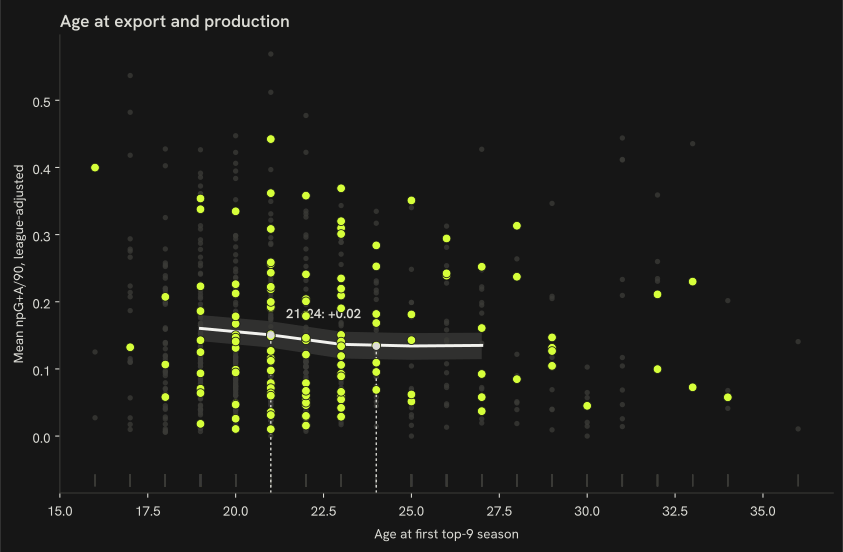
Age at the first top-9 season and output over the first two seasons, 691 exports
Players who reach a top-9 league at 21 produce +0.017 more league-adjusted goals plus assists per 90 over their first two seasons than those arriving at 24 (90 % HDI 0.004 to 0.028, n = 691 exports).
How to read it: the horizontal axis is a player’s age in his first top-9 season; the vertical axis is his league-adjusted goals plus assists per 90 over the first two seasons there. The line is the model’s expected value at each age, the band its 90 % interval; a flat line means no measurable difference in output by arrival age. Green dots are Spanish exports — hover for the name.
How we know
At 21: 0.15 (90 % HDI 0.13–0.17); at 24: 0.13 (0.11–0.15); the difference +0.017 (0.004 to 0.028). Spanish exports in the model sample reached a top-9 league at a median age of 22 (n = 133).
As an analytics question In numbers: mean league-adjusted goals + assists per 90 over the first two top-9 seasons, as a function of age at the first one, given origin-league strength and position, 691 peer-nationality exports.
What we did We looked at the age a player first arrived in one of the strongest leagues and checked whether players who arrived earlier ended up producing more, once we accounted for the strength of the league they came from.
Sources Age curve (natural cubic spline) on league-adjusted production, given origin-league strength (§ Methodology), position and a country effect, 691 peer-nationality exports (Gelman et al., 2013; Hoffman and Gelman, 2014); 90 % HDI; better players tend to leave earlier, so the curve mixes selection with development and this atlas does not separate them.
What this means
Across 691 exports from the peer countries, arriving at 21 goes with +0.017 more league-adjusted goals plus assists per 90 than arriving at 24, with the interval above. The curve mixes selection (better players leave earlier) with any effect of leaving young, so it is an association and not an estimate of what an earlier move would do for a given player.
What this does not show
Players who never reached a top-9 league, output after the first two seasons, and minutes, which a player may not get at all after an early move.
Data snapshot: FBref tables fetched 14 September 2026, snapshot commit ef7dbd4 · code: src/export_age_model.py · status: exploratory, not pre-registered · all limitations