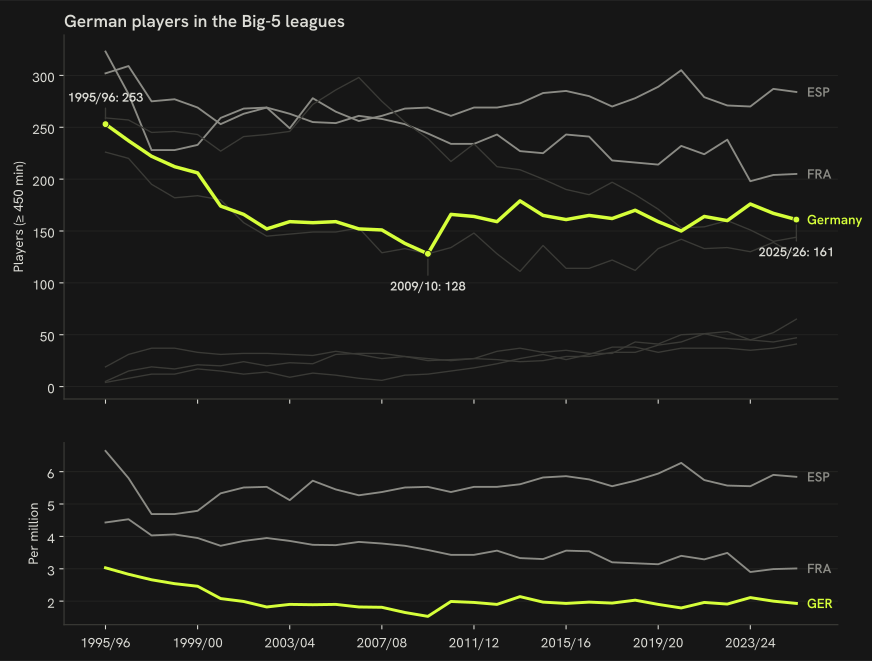
German players with 450+ minutes in the Big-5 leagues per season, 1995/96 to 2025/26
German players with ≥ 450 Big-5 minutes numbered 253 at the 1995/96 peak, 128 at the 2009/10 low and 161 in 2025/26.
How to read it: each line is one country’s count of players with at least 450 minutes in the five biggest leagues, season by season since 1995/96. German players are the green line; the dashed rule marked “break” is the season the model dates the fall to, with its posterior probability; the model’s other step is not a rise of 5 % or more and is not marked; the point past the last season is the forecast for next season with its 90 % interval. Toggle countries and switch to per million to compare fairly across sizes.
The change-point model’s most probable season for the fall is 2000/01 (posterior 78 %), a level change of ×0.75 (90 % HDI 0.65–0.89).
Change-point fit: max R-hat 1.003, minimum bulk ESS 1730, minimum tail ESS 2128, 0 divergent transitions, within the convergence rule fixed before the refit of 1 October 2026 (R-hat ≤ 1.01, bulk and tail ESS ≥ 400, no divergences).
How we know
As an analytics question In numbers: German players with ≥ 450 minutes in the Big-5 leagues each season since 1995/96, with each step in the level that a change-point model can date.
What we did We counted, season by season, how many home-nation players had real playing time in Europe's five biggest leagues, then asked a change-point model for the most probable seasons of a lasting rise and a lasting fall, with a probability on each.
Sources FBref Big-5 player tables 1995/96 → 2025/26; peers on the same rule. The names are, for each of the three seasons with the highest counts, the German players with the most Big-5 minutes that season, goalkeepers included, listed as a record of presence and not as a quality ranking: 1995/96: Eike Immel, Jörg Schmadtke, Jörg Albertz; 1996/97: Bodo Illgner, Andreas Köpke, Oliver Reck; 1997/98: Jens Lehmann, Oliver Kahn, Uwe Kamps. The dates come from a Bayesian local-level model with two ordered change points, one for the rise and one for the fall (Adams and MacKay, 2007); detail in § Methodology.
What this means
The model’s most probable season for the fall is 2000/01 (posterior 78 %; level ×0.75, 90 % HDI 0.65–0.89). A break model describes the timing of a change in level; it identifies no cause, and the posterior says how sure the model is of the season. The forecast is the one registered item in the atlas and is scored only when the season’s tables are final.
What this does not show
Players in leagues outside the Big-5 (the top-9 count on the per-head page is wider), why the level changed, and any season beyond the one registered forecast.
Data snapshot: FBref tables fetched 14 September 2026, snapshot commit ef7dbd4 · code: src/big5_series.py, src/series_model.py · status: exploratory, not pre-registered · all limitations