Summary · Question 3 of 14
Explore the data
Benchmark vs peer countries
Structural benchmark vs peer countries
The tables below count German players in the top-9 leagues by position group and age cohort against the peer countries, from the same season tables as every other count in the atlas.
Cohort gaps — forwards
| Cohort | U22 | 23-25 | 26-29 | 30+ |
|---|---|---|---|---|
| Germany | 5 | 5 | 8 | 8 |
| France | 10 | 9 | 15 | 6 |
| Spain | 6 | 10 | 12 | 10 |
| Italy | 3 | 7 | 8 | 4 |
| England | 2 | 4 | 6 | 7 |
Cohort gaps — midfielders
| Cohort | U22 | 23-25 | 26-29 | 30+ |
|---|---|---|---|---|
| Germany | 15 | 24 | 19 | 26 |
| France | 27 | 48 | 35 | 27 |
| Spain | 17 | 55 | 44 | 39 |
| Italy | 8 | 18 | 22 | 16 |
| England | 15 | 17 | 25 | 9 |
Cohort gaps — defenders
| Cohort | U22 | 23-25 | 26-29 | 30+ |
|---|---|---|---|---|
| Germany | 9 | 6 | 22 | 27 |
| France | 15 | 23 | 25 | 15 |
| Spain | 17 | 29 | 34 | 38 |
| Italy | 7 | 12 | 14 | 15 |
| England | 6 | 11 | 20 | 15 |
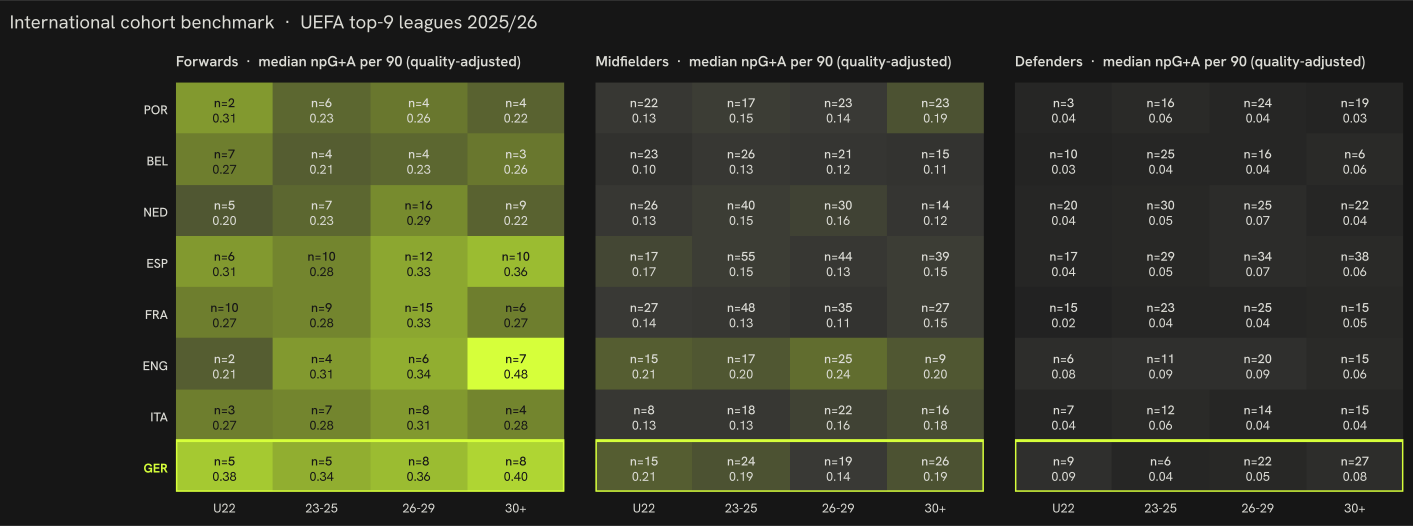
* Count and median npG+A per 90 of players with the country's nationality in a top-9 league, 2025/26, at least 450 minutes; cohort by age at the season's calendar turn (start year + 1 − birth year). 5 of the 8 countries are shown; the heatmap above carries all of them. Largest German shortfalls against the peer median count: defenders 23-25 (6 vs 23), midfielders U22 (15 vs 22), midfielders 26-29 (19 vs 25).
The full picture, all nine peer countries at once, as a heatmap:
Observations
Per capita: rank 8 of 8 · The largest cohort gap: defenders 23-25 · Trajectories 2024/25 → 2025/26: mostly stable
Per capita: rank 8 of 8
262 German players on 2025/26 rosters of the nine strongest leagues give 3.13 per million inhabitants, rank 8 of 8. Portugal leads with 25.19, 8.0 times the German density; Italy sits one place above with 3.41 from 201 players and a population 1.4 times smaller. No peer sits below.
The largest cohort gap: defenders 23-25
Counting 2025/26 top-9 players by position group and age cohort and comparing the German count with the median of the other seven peers, the three largest shortfalls are defenders 23-25 — 6 German against a peer median of 23; midfielders U22 — 15 German against a peer median of 22; midfielders 26-29 — 19 German against a peer median of 25. The cohort tables above show the medians behind the counts.
Trajectories 2024/25 → 2025/26: mostly stable
178 German-eligible players had at least 900 minutes in both 2024/25 and 2025/26: forwards 22 (5 up, 7 stable, 10 down); midfielders 76 (14 up, 47 stable, 15 down); defenders 80 (13 up, 59 stable, 8 down). A move counts as up or down when league-adjusted goals + assists per 90 changed by more than 0.05; 113 of 178 stayed within that band. These are season-over-season deltas, not projections.